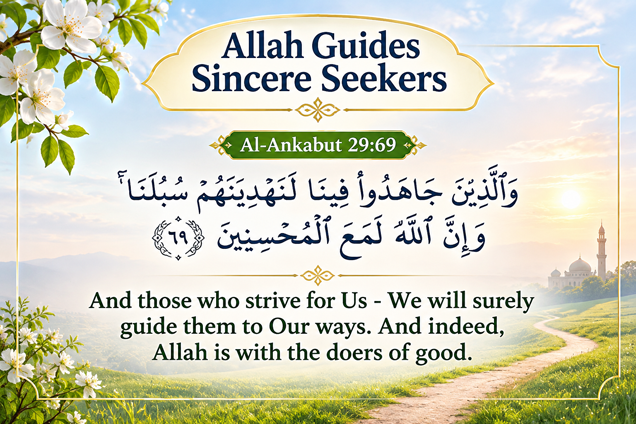
 Qur’anic Verses About Guidance to the Truthلهداية إلى الحق
20 selecte
 {loadmoduleid 116}
 1. Fulfill an Obligation Upon Us
Da’wah is recognised by the majority of scholars as being obligat
 Quran verses about Dawah
مَا عَلَى الرَّسُولِ إِلَّا الْبَلَاغُ و
 Objection to Islam is often raised against the death penalty prescribed for apostasy (abandonment
 Homosexualityand lesbianism have been dubbed “alternative life-styles,” “personal prefe
- Details
- Written by Administrator
- Category: Introduction to Dawah
- Hits: 152

What is Islam?
Islam is not a new religion, but the same truth that God revealed through all His prophets to every people. For a fifth of the world’s population, Islam is both a religion and a complete way of life. Muslims follow a religion of peace, mercy, and forgiveness, and the majority have nothing to do with the extremely grave events which have come to be associated with their faith.
Who are the Muslims?
One billion people from a vast range of races, nationalities and cultures across the globe – from the southern Philippines to Nigeria – are united by their common Islamic faith. About 18% live in the Arab world; the world’s largest Muslim community is in Indonesia; substantial parts of Asia and most of Africa are Muslim, while significant minorities are to be found in the former Soviet Union, China, North and South America, and Europe.
What do Muslims believe?
Muslims believe in One, Unique, Incomparable God; in the Angels created by Him; in the prophets through whom His revelations were brought to mankind; in the Day of Judgement and individual accountability for actions; in God’s complete authority over human destiny and in life after death.
Muslims believe in a chain of prophets starting with Adam and including Noah, Abraham, Ishmael, Isaac, Jacob, Joseph, Job, Moses, Aaron, David, Solomon, Elias, Jonah, John the Baptist, and Jesus, peace be upon them.
But God’s final message to man, a reconfirmation of the eternal message and a summing-up of all that has gone before was revealed to the Prophet Muhammad (PBUH) through Gabriel.
How does someone become a Muslim?
Simply by saying ‘there is no divinity worthy to be worshipped apart from Allah, and Muhammad (PBUH) is the Messenger of God.’
By this declaration the believer announces his or her faith in all God’s messengers, and the scriptures they brought.
The Shahada can be declared as follows :
“ASH-HADU ANLA ELAHA ILLA-ALLAH WA ASH-HADU ANNA MOHAMMADAN RASUL-ALLAH”.
The English translation is :
“I bear witness that there is no deity (none truly to be worshipped) but, Allah, and I bear witness that Mohammad is the messenger of Allah.”
What does ‘Islam’ mean?
The Arabic word ‘Islam’ simply means ‘submission’, and derives from a word meaning ‘peace’. In a religious context it means complete submission to the will of God. ‘Mohammedanism’ is thus a misnomer because it suggests that Muslims worship Muhammad (PBUH) rather than God. ‘Allah’ is the Arabic name for God, which is used by Arab Muslims and Christians alike.
Why does Islam often seem strange?
Islam may seem exotic or even extreme in the modern world. Perhaps this is because religion does not dominate everyday life in the West today, whereas Muslims have religion always uppermost in their minds, and make no division between secular and sacred. They believe that the Divine Law, the Shari’a, should be taken very seriously, which is why issues related to religion are still so important.
Do Islam and Christianity have different origins?
No. Together with Judaism, they go back to the prophet and patriarch Abraham, and their three prophets are directly descended from his sons Muhammad (PBUH) from the eldest, Ishmael, and Moses and Jesus from Isaac. Abraham established the settlement which today is the city of Makkah, and built the Ka’ba towards which all Muslims turn when they pray.
What is the Ka’ba?
The Ka’ba is the place of worship which God commanded Abraham and Ishmael to build over four thousand years ago. The building was constructed of stone on what many believe was the original site of a sanctuary established by Adam.
God commanded Abraham to summon all mankind to visit this place, and when pilgrims go there today they say ‘At Thy service, O Lord’, in response to Abraham’s summons.
Who is Muhammad (PBUH) ?
Muhammad (PBUH) , was born in Makkah in the year 570, at a time when Christianity was not yet fully established in Europe. Since his father died before his birth, and his mother shortly afterwards, he was raised by his uncle from the respected tribe of Quraysh. As he grew up, he became known for his truthfulness, generosity and sincerity, so that he was sought after for his ability to arbitrate in disputes.
The historians describe him as calm and meditative. Muhammad (PBUH) was of a deeply religious nature, and had long detested the decadence of his society. It became his habit to meditate from time to time in the Cave of Hira near the summit of Jabal al-Nur, the ‘Mountain of Light’ near Makkah
How did Muhammad (PBUH) become a prophet and a messenger of God?
The Mountain of Light where Gabriel came to Prophet Muhammad (PBUH) . At the age of 40, while engaged in a meditative retreat, Muhammad (PBUH) received his first revelation from God through the Angel Gabriel. This revelation, which continued for twenty-three years, is known as the Quran.
As soon as he began to recite the words he heard from Gabriel, and to preach the truth which God had revealed to him, he and his small group of followers suffered bitter persecution, which grew so fierce that in the year 622 God gave them the command to emigrate. This event, the Hijra, ‘migration’, in which they left Makkah for the city of Madinah some 260 miles to the north, marks the beginning of the Muslim calendar.
After several years, the Prophet and his followers were able to return to Makkah, where they forgave their enemies and established Islam definitively. Before the Prophet died at the age of 63, the greater part of Arabia was Muslim, and within a century of his death Islam had spread to Spain in the West and as far East as China.
Among the reasons for the rapid and peaceful spread of Islam was the simplicity of its doctrine – Islam calls for faith in only One God worthy of worship. It also repeatedly instructs man to use his powers of intelligence and observation.
Within a few years, great civilizations and universities were flourishing, for according to the Prophet, ‘seeking knowledge is an obligation for every Muslim man and woman’. The synthesis of Eastern and Western ideas and of new thought with old, brought about great advances in medicine, mathematics, physics, astronomy, geography, architecture, art, literature, and history. Many crucial systems such as algebra, the Arabic numerals, and also the concept of the zero (vital to the advancement of mathematics), were transmitted to medieval Europe from Islam. Sophisticated instruments which were to make possible the European voyages of discovery were developed, including the astrolabe, the quadrant and good navigational maps.
What is the Quran?
The Quran is a record of the exact words revealed by God through the Angel Gabriel to the Prophet Muhammad (PBUH) . It was memorized by Muhammad (PBUH) and then dictated to his Companions, and written down by scribes, who cross-checked it during his lifetime. Not one word of its 114 chapters, Suras, has been changed over the centuries, so that the Quran is in every detail the unique and miraculous text which was revealed to Muhammad (PBUH) fourteen centuries ago.
This opening chapter of The Quran, the Fatiha, is central in Islamic prayer. It contains the essence of The Quran and is recited during every prayer.
What is the Quran about?
The Quran, the last revealed Word of God, is the prime source of every Muslim’s faith and practice. It deals with all the subjects which concern us as human beings: wisdom, doctrine, worship, and law, but its basic theme is the relationship between God and His creatures. At the same time it provides guidelines for a just society, proper human conduct and an equitable economic system.
Are there any other sacred sources?
Yes, the sunnah, the practice and example of the Prophet, is the second authority for Muslims. A hadith is a reliably transmitted report of what the Prophet said, did, or approved. Belief in the sunnah is part of the Islamic faith.
Examples of the Prophet’s sayings The Prophet said:
‘God has no mercy on one who has no mercy for others.’
‘None of you truly believes until he wishes for his brother what he wishes for himself.’
‘He who eats his fill while his neighbor goes without food is not a believer.’
‘The truthful and trusty businessman is associated with the prophets the saints, and the martyrs.’
‘Powerful is not he who knocks the other down, indeed powerful is he who controls himself in a fit of anger.’
‘God does not judge according to your bodies and appearances but He scans your hearts and looks into your deeds.’
‘A man walking along a path felt very thirsty. Reaching a well he descended into it, drank his fill and came up. Then he saw a dog with its tongue hanging out, trying to lick up mud to quench its thirst. The man saw that the dog was feeling the same thirst as he had felt so he went down into the well again and filled his shoe with water and gave the dog a drink. God forgave his sins for this action.’ The Prophet was asked: ‘Messenger of God, are we rewarded for kindness towards animals?’ He said, ‘There is a reward for kindness to every living thing.’
From the hadith collections of Bukhari, Muslim, Tirmidhi and Bayhaqi.
What are the ‘Five Pillars’ of Islam?
They are the framework of the Muslim life: faith, prayer, concern for the needy, self-purification, and the pilgrimage to Makkah for those who are able.
1- FAITH
2 – PRAYER
3 – THE ‘ZAKAT’
4 – THE FAST
5 – PILGRIMAGE (Hajj)
“There is no god worthy of worship except God and Muhammad (PBUH) is His messenger.”
This declaration of faith is called the Shahada, a simple formula which all the faithful pronounce.
In Arabic, the first part is: La ilaha illa Llah – ‘there is no god except God’;
ilaha (god) can refer to anything which we may be tempted to put in place of God – wealth, power, and the like.
Then comes illa Llah : ‘except God’, the source of all Creation.
The second part of the Shahada is Muhammad un rasulu’Llah : ‘Muhammad (PBUH) is the messenger of God.’
A message of guidance has come through a man like ourselves.
Salat is the name for the obligatory prayers which are performed five times a day, and are a direct link between the worshipper and God.
There is no hierarchical authority in Islam, and no priests, so the prayers are led by a learned person who knows the Quran, chosen by the congregation.
These five prayers contain verses from the Quran, and are said in Arabic, the language of the Revelation, but personal supplication can be offered in one’s own language.
Prayers are said at dawn, noon, mid-afternoon, sunset and nightfall, and thus determine the rhythm of the entire day. Although it is preferable to worship together in a mosque, a Muslim may pray almost anywhere, such as in fields, offices, factories and universities. Visitors to the Muslim world are struck by the centrality of prayers in daily life.
A translation of the Call to Prayer is:
Allah is most great. Allah is most great.
Allah is most great. Allah is most great.
I testify that there is no divinity except Allah .
I testify that there is no divinity except Allah .
I testify that Muhammad (PBUH) is the messenger of Allah.
I testify that Muhammad (PBUH) is the messenger of Allah.
Come to prayer! Come to prayer!
Come to success (in this life and the Hereafter)!
Come to success!
Allah is most great. Allah is most great.
There is no divinity except Allah .
One of the most important principles of Islam is that all things belong to God, and that wealth is therefore held by human beings in trust. The word zakat means both ‘purification’ and ‘growth’. Our possessions are purified by setting aside a proportion for those in need, and, like the pruning of plants, this cutting back balances and encourages new growth.
Each Muslim calculates his or her own zakat individually. For most purposes this involves the payment each year of two and a half percent of one’s capital.
A pious person may also give as much as he or she pleases as sadaqa, and does so preferably in secret. Although this word can be translated as ‘voluntary charity’ it has a wider meaning. The Prophet said ‘even meeting your brother with a cheerful face is charity.’
The Prophet said: ‘Charity is a necessity for every Muslim.’ He was asked: ‘What if a person has nothing?’ The Prophet replied: ‘He should work with his own hands for his benefit and then give something out of such earnings in charity.’ The Companions asked: ‘What if he is not able to work?’ The Prophet said: ‘He should help poor and needy persons.’ The Companions further asked ‘What if he cannot do even that?’ The Prophet said ‘He should urge others to do good.’ The Companions said ‘What if he lacks that also?’ The Prophet said ‘He should check himself from doing evil. That is also charity.’
Every year in the month of Ramadan, all Muslims fast from first light until sunset, abstaining from food, drink, and sexual relations.
Those who are sick, elderly, or on a journey, and women who are pregnant or nursing are permitted to break the fast and make up an equal number of days later in the year. If they are physically unable to do this, they must feed a needy person for every day missed. Children begin to fast (and to observe the prayer) from puberty, although many start earlier.
Although the fast is most beneficial to the health, it is regarded principally as a method of self purification. By cutting oneself off from worldly comforts, even for a short time, a fasting person gains true sympathy with those who go hungry as well as growth in one’s spiritual life.
The annual pilgrimage to Makkah – the Hajj – is an obligation only for those who are physically and financially able to perform it. Nevertheless, over two million people go to Makkah each year from every corner of the globe providing a unique opportunity for those of different nations to meet one another.
Although Makkah is always filled with visitors, the annual Hajj begins in the twelfth month of the Islamic year (which is lunar, not solar, so that Hajj and Ramadan fall sometimes in summer, sometimes in winter). Pilgrims wear special clothes: simple garments which strip away distinctions of class and culture, so that all stand equal before God.
The rites of the Hajj, which are of Abrahamic origin, include circling the Ka’ba seven times, and going seven times between the mountains of Safa and Marwa as did Hagar during her search for water. Then the pilgrims stand together on the wide plain of Arafa and join in prayers for God’s forgiveness, in what is often thought of as a preview of the Last Judgment.
In previous centuries the Hajj was an arduous undertaking. Today, however, Saudi Arabia provides millions of people with water, modern transport, and the most up-to-date health facilities.
The close of the Hajj is marked by a festival, the Eid al-Adha, which is celebrated with prayers and the exchange of gifts in Muslim communities everywhere. This, and the Eid al-Fitr, a feast-day commemorating the end of Ramadan, are the main festivals of the Muslim calendar.
Does Islam tolerate other beliefs?
The Quran says:
لَا يَنْهَاكُمُ اللَّهُ عَنِ الَّذِينَ لَمْ يُقَاتِلُوكُمْ فِي الدِّينِ وَلَمْ يُخْرِجُوكُمْ مِنْ دِيَارِكُمْ أَنْ تَبَرُّوهُمْ وَتُقْسِطُوا إِلَيْهِمْ إِنَّ اللَّهَ يُحِبُّ الْمُقْسِطِينَ
“God forbids you not, with regards to those who fight you not for [your] faith nor drive you out of your homes, from dealing kindly and justly with them; for God loveth those who are just. (Quran 60:8)
It is one function of Islamic law to protect the privileged status of minorities, and this is why non-Muslim places of worship have flourished all over the Islamic world. History provides many examples of Muslim tolerance towards other faiths: when the caliph Omar entered Jerusalem in the year 634, Islam granted freedom of worship to all religious communities in the city.
Islamic law also permits non-Muslim minorities to set up their own courts, which implement family laws drawn up by the minorities themselves.
What do Muslims think about Jesus?
Muslims respect and revere Jesus, and await his Second Coming. They consider him one of the greatest of God’s messengers to mankind. A Muslim never refers to him simply as ‘Jesus’, but always adds the phrase ‘upon him be peace’. The Quran confirms his virgin birth (a chapter of the Quran is entitled ‘Mary’), and Mary is considered the purest woman in all creation.
The Quran describes the Annunciation as follows:
وَإِذْ قَالَتِ الْمَلَائِكَةُ يَامَرْيَمُ إِنَّ اللَّهَ اصْطَفَاكِ وَطَهَّرَكِ وَاصْطَفَاكِ عَلَى نِسَاءِ الْعَالَمِينَ (42) يَامَرْيَمُ اقْنُتِي لِرَبِّكِ وَاسْجُدِي وَارْكَعِي مَعَ الرَّاكِعِينَ (43) ذَلِكَ مِنْ أَنْبَاءِ الْغَيْبِ نُوحِيهِ إِلَيْكَ وَمَا كُنْتَ لَدَيْهِمْ إِذْ يُلْقُونَ أَقْلَامَهُمْ أَيُّهُمْ يَكْفُلُ مَرْيَمَ وَمَا كُنْتَ لَدَيْهِمْ إِذْ يَخْتَصِمُونَ (44) إِذْ قَالَتِ الْمَلَائِكَةُ يَامَرْيَمُ إِنَّ اللَّهَ يُبَشِّرُكِ بِكَلِمَةٍ مِنْهُ اسْمُهُ الْمَسِيحُ عِيسَى ابْنُ مَرْيَمَ وَجِيهًا فِي الدُّنْيَا وَالْآخِرَةِ وَمِنَ الْمُقَرَّبِينَ (45) وَيُكَلِّمُ النَّاسَ فِي الْمَهْدِ وَكَهْلًا وَمِنَ الصَّالِحِينَ (46) قَالَتْ رَبِّ أَنَّى يَكُونُ لِي وَلَدٌ وَلَمْ يَمْسَسْنِي بَشَرٌ قَالَ كَذَلِكِ اللَّهُ يَخْلُقُ مَا يَشَاءُ إِذَا قَضَى أَمْرًا فَإِنَّمَا يَقُولُ لَهُ كُنْ فَيَكُونُ (47)
‘Behold!’ the Angel said, ‘God has chosen you, and purified you, and chosen you above the women of all nations. O Mary, God gives you good news of a word from Him, whose name shall be the Messiah, Jesus son of Mary, honored in this world and the Hereafter, and one of those brought near to God. He shall speak to the people from his cradle and in maturity, and shall be of the righteous.’
She said: ‘O my Lord! How shall I have a son when no man has touched me?’ He said: ‘Even so; God creates what He will. When He decrees a thing, He says to it, “Be!” and it is.’ (Quran 3:42-47)
Jesus was born miraculously through the same power which had brought Adam into being without a father:
إِنَّ مَثَلَ عِيسَى عِنْدَ اللَّهِ كَمَثَلِ آدَمَ خَلَقَهُ مِنْ تُرَابٍ ثُمَّ قَالَ لَهُ كُنْ فَيَكُونُ
Truly, the likeness of Jesus with God is as the likeness of Adam. He created him of dust, and then said to him, ‘Be!’ and he was. (Quran 3:59)
During his prophetic mission Jesus performed many miracles. The Quran tells us that he said:
أَنِّي قَدْ جِئْتُكُمْ بِآيَةٍ مِنْ رَبِّكُمْ أَنِّي أَخْلُقُ لَكُمْ مِنَ الطِّينِ كَهَيْئَةِ الطَّيْرِ فَأَنْفُخُ فِيهِ فَيَكُونُ طَيْرًا بِإِذْنِ اللَّهِ وَأُبْرِئُ الْأَكْمَهَ وَالْأَبْرَصَ وَأُحْيِ الْمَوْتَى بِإِذْنِ اللَّهِ وَأُنَبِّئُكُمْ بِمَا تَأْكُلُونَ وَمَا تَدَّخِرُونَ فِي بُيُوتِكُمْ إِنَّ فِي ذَلِكَ لَآيَةً لَكُمْ إِنْ كُنْتُمْ مُؤْمِنِينَ
I have come to you with a sign from your Lord: I make for you out of clay, as it were, the figure of a bird, and breathe into it and it becomes a bird by God’s leave. And I heal the blind, and the lepers and I raise the dead by God’s leave. (Quran 3:49)
Neither Muhammad (PBUH) nor Jesus came to change the basic doctrine of the belief in One God, brought by earlier prophets, but to confirm and renew it. In the Quran Jesus is reported as saying that he came:
وَمُصَدِّقًا لِمَا بَيْنَ يَدَيَّ مِنَ التَّوْرَاةِ وَلِأُحِلَّ لَكُمْ بَعْضَ الَّذِي حُرِّمَ عَلَيْكُمْ وَجِئْتُكُمْ بِآيَةٍ مِنْ رَبِّكُمْ فَاتَّقُوا اللَّهَ وَأَطِيعُونِ
To attest the law which was before me. And to make lawful to you part of what was forbidden to you; I have come to you with a sign from your Lord, so fear God and obey Me. (Quran 3:5O)
The Prophet Muhammad (PBUH) said:
“Whoever believes there is no god but God, alone without partner, that Muhammad (PBUH) is His messenger, that Jesus is the servant and messenger of God, His word breathed into Mary and a spirit emanating from Him, and that Paradise and Hell are true, shall be received by God into Heaven.” (Hadith from Bukhari)
Why is the family so important to Muslims?
The family is the foundation of Islamic society. The peace and security offered by a stable family unit is greatly valued, and seen as essential for the spiritual growth of its members. A harmonious social order is created by the existence of extended families; children are treasured, and rarely leave home until the time they marry.
What about Muslim women?
Islam sees a woman, whether single or married, as an individual in her own right, with the right to own and dispose of her property and earnings. A marriage dowry is given by the groom to the bride for her own personal use, and she keeps her own family name rather than taking her husband’s.
Both men and women are expected to dress in a way which is modest and dignified; the traditions of female dress found in some Muslim countries are often the expression of local customs.
The Messenger of God said:
‘The most perfect in faith amongst believers is he who is best in manner and kindest to his wife.’
Can a Muslim have more than one wife?
The religion of Islam was revealed for all societies and all times and so accommodates widely differing social requirements. Circumstances may warrant the taking of another wife but the right is granted, according to the Quran, only on condition that the husband is scrupulously fair.
Is Islamic marriage like Christian marriage?
A Muslim marriage is not a ‘sacrament’, but a simple, legal agreement in which either partner is free to include conditions. Marriage customs thus vary widely from country to country. As a result, divorce is not common, although it is not forbidden as a last resort. According to Islam, no Muslim girl can be forced to marry against her will: her parents will simply suggest young men they think may be suitable.
How do Muslims treat the elderly?
In the Islamic world there are no old people’s homes. The strain of caring for one’s parents in this most difficult time of their lives is considered an honor and blessing, and an opportunity for great spiritual growth. God asks that we not only pray for our parents, but act with limitless compassion, remembering that when we were helpless children they preferred us to themselves.
Mothers are particularly honored: the Prophet taught that ‘Paradise lies at the feet of mothers’. When they reach old age, Muslim parents are treated mercifully, with the same kindness and selflessness.
In Islam, serving one’s parents is a duty second only to prayer, and it is their right to expect it. It is considered despicable to express any irritation when, through no fault of their own, the old become difficult.
The Quran says:
وَقَضَى رَبُّكَ أَلَّا تَعْبُدُوا إِلَّا إِيَّاهُ وَبِالْوَالِدَيْنِ إِحْسَانًا إِمَّا يَبْلُغَنَّ عِنْدَكَ الْكِبَرَ أَحَدُهُمَا أَوْ كِلَاهُمَا فَلَا تَقُلْ لَهُمَا أُفٍّ وَلَا تَنْهَرْهُمَا وَقُلْ لَهُمَا قَوْلًا كَرِيمًا (23) وَاخْفِضْ لَهُمَا جَنَاحَ الذُّلِّ مِنَ الرَّحْمَةِ وَقُلْ رَبِّ ارْحَمْهُمَا كَمَا رَبَّيَانِي صَغِيرًا (24)
‘Your Lord has commanded that you worship none but Him, and be kind to parents. If either or both of them reach old age with you, do not say ‘uff to them or chide them, but speak to them in terms of honor and kindness. Treat them with humility, and say, ‘My Lord! Have mercy on them, for they did care for me when I was little’. (17:23-24)
How do Muslims view death?
Like Jews and Christians, Muslims believe that the present life is only a trial preparation for the next realm of existence. Basic articles of faith include: the Day of Judgment, resurrection, Heaven and Hell.
When a Muslim dies, he or she is washed, usually by a family member, wrapped in a clean white cloth, and buried with a simple prayer preferably the same day. Muslims consider this one of the final services they can do for their relatives, and an opportunity to remember their own brief existence here on earth.
The Prophet taught that three things can continue to help a person even after death; charity which he had given, knowledge which he had taught and prayers on their behalf by a righteous child.
What does Islam say about war?
Like Christianity, Islam permits fighting in self-defense, in defense of religion, or on the part of those who have been expelled forcibly from their homes. It lays down strict rules of combat which include prohibitions against harming civilians and against destroying crops, trees and livestock. As Muslims see it, injustice would be triumphant in the world if good men were not prepared to risk their lives in a righteous cause.
The Quran says:
وَقَاتِلُوا فِي سَبِيلِ اللَّهِ الَّذِينَ يُقَاتِلُونَكُمْ وَلَا تَعْتَدُوا إِنَّ اللَّهَ لَا يُحِبُّ الْمُعْتَدِينَ
Fight in the cause of God against those who fight you, but do not transgress limits. God does not love transgressors. (2:190)
وَإِنْ جَنَحُوا لِلسَّلْمِ فَاجْنَحْ لَهَا وَتَوَكَّلْ عَلَى اللَّهِ إِنَّهُ هُوَ السَّمِيعُ الْعَلِيمُ
And if they incline to peace, then incline to it [also] and rely upon Allah. Indeed, it is He who is the Hearing, the Knowing. (8:61)
War, therefore, is the last resort, and is subject to the rigorous conditions laid down by the sacred law. The term jihad literally means ‘struggle’, and Muslims believe that there are two kinds of jihad. The other ‘jihad’ is the inner struggle which everyone wages against egotistic desires, for the sake of attaining inner peace.
What about food?
Although much simpler than the dietary law followed by Jews and the early Christians, the code which Muslims observe forbids the consumption of pig meat or any kind of intoxicating drink.
The Prophet taught that ‘your body has rights over you ’, and the consumption of wholesome food and the leading of a healthy lifestyle are seen as religious obligations.
The Prophet said: ‘Ask God for certainty [of faith] and well-being; for after certainty, no one is given any gift better than health!’
How does Islam guarantee human rights?
Freedom of conscience is laid down by the Quran itself:
لَا إِكْرَاهَ فِي الدِّينِ
‘There is no compulsion in religion’. (2:256)
يَاأَيُّهَا النَّاسُ إِنَّا خَلَقْنَاكُمْ مِنْ ذَكَرٍ وَأُنْثَى وَجَعَلْنَاكُمْ شُعُوبًا وَقَبَائِلَ لِتَعَارَفُوا إِنَّ أَكْرَمَكُمْ عِنْدَ اللَّهِ أَتْقَاكُمْ إِنَّ اللَّهَ عَلِيمٌ خَبِيرٌ
O mankind! We created you from a single soul, male and female, and made you into nations and tribes, so that you may come to know one another. Truly, the most honored of you in God’s sight is the greatest of you in piety. God is All-Knowing, All Aware (49:13)
- Details
- Written by Administrator
- Category: Introduction to Dawah
- Hits: 158
As an example of the level of awareness of the first Muslims we will reflect on the story of Jafar ibn Abi Talib.
Jafar ibn Abi Talib was a cousin of Prophet Muhammad (?) , peace be upon him, and brother of Ali, the fourth caliph of Islam. He was among the first people to convert to Islam and experienced firsthand the persecution that the pagan Meccans doled out to the tiny community of Muslims.
Hence, when the opportunity arose to migrate to Abyssinia, present-day Ethiopia, he accompanied his wife and a small band of believers. Soon they settled down in the new land under the care and protection of the Negus (King of Ethiopia), the just and righteous ruler of Abyssinia. For the first time since they became Muslims, they savored the taste of freedom and security and enjoyed the sweetness of worship undisturbed.
Meccans Seek Extradition Of Muslims
When their fellow Meccans learned of the departure of these Muslims, they made plans to secure their return. They sent two of their most formidable men, Amr ibn al-Aas and Abdullah ibn Abi Rabiah, to accomplish this task and provided them with valuable gifts for the Negus (King of Ethiopia) and his bishops. In Abyssinia, the two Meccan emissaries first presented their gifts to the bishops and asked for their support when they approach the King.
Amr and Abdullah then went to the Negus (King of Ethiopia) himself and presented him with gifts which he greatly admired. They said to him, “O King, there is a group of evil persons from among our youth who have escaped to your kingdom. They practice a religion which neither we nor you know. They have forsaken our religion and have not entered into your religion. The respected leaders of their people – from among their own parents and uncles and from their own clans – have sent us to you to request you to return them. They know best what trouble they have caused.” The Negus (King of Ethiopia) looked towards his bishops who said, “They speak the truth, O King. Their own people know them better and are better acquainted with what they have done. Send them back so that they themselves might judge them.”
The Interfaith Dialogue With The Negus (King Of Ethiopia)
The Negus (King of Ethiopia) was not pleased with this suggestion and said, “No. By Allah, I won’t surrender them to anyone until I myself call them and question them about what they have been accused. If what these two men have said is true, then I will hand them over to you. If however it is not so, then I shall protect them so long as they desire to remain under my protection.” The Negus (King of Ethiopia) then summoned the Muslims to meet him. Before going, they consulted with one another as a group and agreed that Jafar ibn Abi Talib will speak on their behalf.
In the court, the Negus (King of Ethiopia) turned to them and asked, “What is this religion which you have taken for yourselves and which has served to cut you off from the religion of your people? You also did not enter my religion or the religion of any other community.”
A Clear Way To Make A Presentation Of Islam
Jafar ibn Abi Talib then advanced and made a speech that was moving and eloquent and which is still one of the most compelling descriptions of Islam, the appeal of the noble Prophet, and the depravity of Meccan society at the time. He said:
“O King, we were a people in a state of ignorance and immorality, worshipping idols and eating the flesh of dead animals, committing all sorts of abomination and shameful deeds, breaking the ties of kinship, treating guests badly, and the strong among us exploited the weak. We remained in this state until Allah sent us a Prophet, one of our own people whose lineage, truthfulness, trustworthiness, and integrity were well-known to us. He called us to worship Allah alone and to renounce the stones and the idols which we and our ancestors used to worship besides Allah.”
Jafar continued, “He commanded us to speak the truth, to honor our promises, to be kind to our relations, to be helpful to our neighbors; to cease all forbidden acts, to abstain from bloodshed, to avoid obscenities and false witness; to not appropriate an orphan’s property nor slander chaste women. He ordered us to worship Allah alone and not to associate anything with Him, to uphold prayer, to give charity and to fast in the month of Ramadan. We believed in him and what he brought to us from Allah and we follow him in what he has asked us to do and we keep away from what he forbade us from doing. Thereupon, O King, our people attacked us, visited the severest punishment on us to make us renounce our religion and take us back to the old immorality and the worship of idols. They oppressed us, made life intolerable for us and obstructed us from observing our religion. So we left for your country, choosing you before anyone else, desiring your protection and hoping to live in Justice and peace in your midst.”
The Negus (King of Ethiopia) was impressed and was eager to hear more. He asked Jafar, “Do you have with you something of what your Prophet brought concerning Allah?” Jafar replied that he did. “Then read it to me,” requested the Negus (King of Ethiopia).
In his rich, melodious voice, Jafar recited the first portion of the Quranic chapter titled Mary, which deals with the story of Jesus and his mother Mary. On hearing the words of the Quran, the Negus (King of Ethiopia) was moved to tears. To the Muslims, he said, “The message of your Prophet and that of Jesus came from the same source…” To Amr and his companion, he said, “Go. For, by Allah, I will never surrender them to you.”
The Meccans Incite Animosity
That, however, was not the end of the matter. The wily Amr made up his mind to go to the King the following day “to mention something about the Muslims’ belief which will certainly fill his heart with anger and make him detest them.” The next day, Amr went to the Negus (King of Ethiopia) and said, “O King, these people to whom you have given refuge and whom you protect say something terrible about Jesus the son of Mary. Send for them and ask them what they say about him.” The Negus (King of Ethiopia) summoned the Muslims and Jafar acted as their spokesman once more.
The Negus (King of Ethiopia) asked, “What do you say about Jesus, the son of Mary?” Jafar replied, “Regarding him, we only say what has been revealed to our Prophet.” “And what is that?” enquired the Negus (King of Ethiopia). “Our Prophet says that Jesus is the servant of Allah and His Prophet, His spirit and His word which He cast into Mary the Virgin.” The Negus (King of Ethiopia) exclaimed, “By Allah, Jesus the son of Mary was exactly as your Prophet has described him.”
Justice Prevails
The Negus (King of Ethiopia) told the Muslims to continue to live in security and instructed his attendants to return the gifts the Meccans had brought, who then departed, having failed in their mission.
The Muslims stayed on in the land of the Negus (King of Ethiopia) who proved to be most generous and kind to his guests. Jafar and his wife Asma spent about ten years in Abyssinia before migrating to Medina with their three children, where Prophet Muhammad (?) and his community of Muslims had found a safe haven.
If you know the nature and essence of the message and what it calls to, and the character and qualities of the messenger accepting the owner and sender of the call becomes easy.
Responding To Islamophobia.
We see from the story of Jafar ibn Abi Talib that anti Islam propaganda dates from the time of the Prophet Muhammad.
In a calculated opposite way the Medias propaganda depicts Muslims as violent, unjust, unfair, ignorant backward people. Their goal with this is to drive people away from learning about Islam and the Creator.
Likewise the medias also in a planned and related way depicts Islam as unfair, discriminating, oblivious, a regressive religion unfit for modern advanced civilization.
We the Muslim Muslim Nation (Ummah) have to be aware and assume the responsibility that befell us after the death of the Prophet and the first generation of Muslims.
Until and unless we return to a wholesome inclusive approach to Da’wah (invitation to Allah) our condition will not change as a Muslim Nation (Ummah).
Being silent when we witness all the evil that is being said and done against Islam and Muslims is not acceptable. A quiet Muslim is not a better Muslim. We must denounce all lies and any other forms of injustice that is being perpetrated against Muslims and Islam worldwide.
Proof Is At List In This One Hadith
On the authority of Abu Sa’id al-Khudri, radiyallahu ‘anhu, who said: I heard the Messenger of Allah, sallallahu ‘alayhi wasallam, say:
"When any one of you sees anything that is disapproved (of by Allah), let him change it with his hand. If he is not able to do so, then let him change it with his tongue. And if he is not able to do so, then let him change it with his heart, though that is the weakest (kind of) faith.”
Source: [Muslim]
Explanation Of The Hadith
The essence of the Islamic Da’wah (invitation to Allah) is enjoining the good and forbidding the evil, since whenever a person conveys the Message, he is enjoining good and forbidding evil. Therefore, it is a mistake to consider these two as separate matters, since they are actually performed concurrently and are synonymous.The main objective in fulfilling this obligation is to attain and maximize benefits, and to eliminate or minimize harm.
Page 9 of 11
- You are here:
-
Home

- Introduction to Dawah